
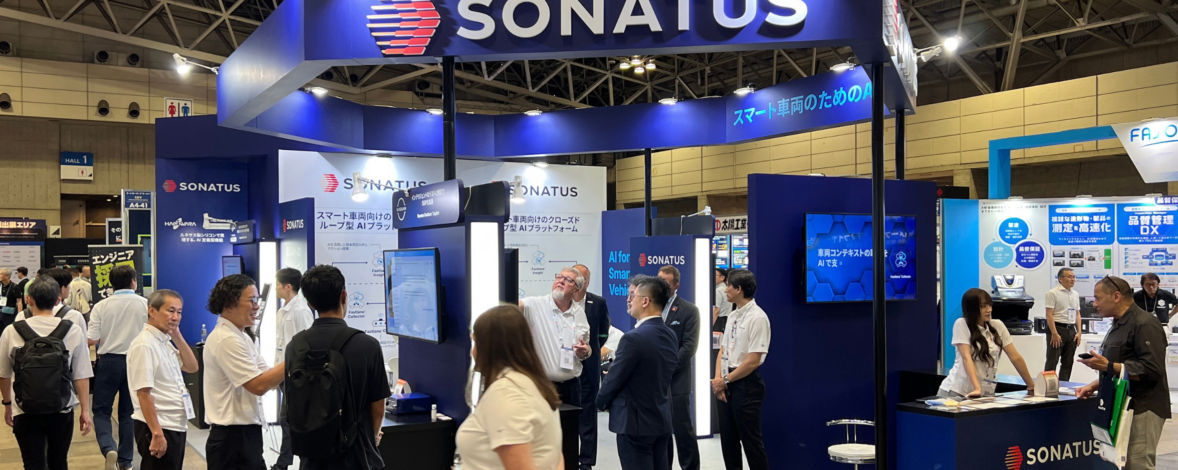
Bringing AI to the SDV
Automotive World Japan is a highly diverse show, made even more so by the fact that the venue hosts several trade shows simultaneously. This September’s edition — the fifth Automotive World — ran September 9–11 at Makuhari Messe in Chiba, drawing roughly 380 exhibitors and an expected 33,000 visitors. It shared the halls with NEPCON Japan, Factory Innovation Week (which itself bundles the SMART FACTORY Expo, RoboDEX, and GREEN FACTORY Expo), Battery Japan, and the Decarbonization Expo — so the breadth of technology on display, from EV components to industrial robotics to next-generation batteries, was genuinely impressive.
On display were components, wiring, and motors for EVs; seats, headrests, dashboards, and other interior components; badges, emblems, and branding manufactured for the OEMs; and a huge assortment of instrument clusters and displays. Had all of this actually been for sale on the show floor, you could have walked away with everything needed to assemble your own vehicle.
One fact could not be overstated: the SDV is powered by AI. Whether presented in the dedicated COVESA or AUTOSAR exhibits, showcased by a partner such as silicon vendor NXP, or exhibited independently as Sonatus did, nearly every exhibitor was highlighting a novel way to incorporate, support, or enable AI-powered software to make smart vehicles a reality.
In Sonatus’s exhibit, we highlighted four demonstrations, each built in collaboration with real partners and customers.
Virtualization with Red Hat
Sonatus and Red Hat showed how virtual vehicles, hosted on Red Hat OpenShift, let engineering teams stand up software-defined vehicle environments without waiting on physical hardware. By running the Sonatus in-vehicle software stack inside containerized, cloud-native infrastructure, OEMs and suppliers can start integration and validation work earlier in the program, iterate faster, and scale test environments on demand — shortening the path from concept to SOP.
In-vehicle AI models using Fastlane™ Edge
Working with partners including MOTER, Michelin, and COMPREDICT, Sonatus demonstrated how Fastlane Edge hosts third-party AI and machine-learning models directly in the vehicle. Rather than treating every model as a bespoke integration, Fastlane Edge gives OEMs a common runtime for deploying, updating, and monitoring in-vehicle AI — so models built by tire, sensor, and mobility-data specialists can run alongside the vehicle’s own software without a custom integration effort for each one.
Service Technician Escalation with Fastlane™ Insight
Fastlane Insight was shown in a post-SOP setting: when a customer brings a hard-to-diagnose issue into the dealership, Insight gives service technicians a faster path to root cause by surfacing the relevant vehicle data and context around the reported symptom, rather than relying on trouble codes alone. The result is fewer repeat visits and less time spent trying to reproduce an issue that may only show up intermittently in the field.
Proven Faster Root-Cause Analysis with Fastlane™ Collector and Insight
The fourth demonstration highlighted an ongoing collaboration with Nissan, combining Fastlane Collector, Fastlane Insight, and Fastlane™ Copilot to improve development and validation efficiency. By collecting the right data from the right vehicles at the right time, then applying Fastlane Insight and Copilot to analyze it, engineering teams can cut down the manual effort of root cause analysis and get more value out of every development and prototype vehicle in the fleet.
The common thread running through all four demonstrations is that Sonatus is helping OEMs reduce cost, effort, and time during vehicle development, while also helping them deliver faster, more accurate service to customers after the vehicle is sold. That focus is clearly resonating; it came up in nearly every conversation we had with customers and prospects on the show floor.
A Few Additional Thoughts from the Show Floor
A couple of things stood out beyond our own booth. First, the co-location itself said something about where the industry is headed: an automotive show sharing a hall with battery, robotics, and factory-automation exhibitions more than a scheduling coincidence — it reflects how tightly electrification, automation, and software have become intertwined in vehicle manufacturing. Walking from an EV motor supplier to a RoboDEX demo to a battery-cell manufacturer and back to an SDV panel in the space of an hour is a pretty good way to see the whole picture at once.
Second, on the evening of September 9th, Sonatus co-hosted a COVESA networking event at the Hotel New Otani Makuhari — a good reminder that progress on SDV standards happens as much in rooms like that one as it does on the show floor. The conversations there, with engineers and standards contributors from across the ecosystem, tracked closely with what we were hearing at the booth all week: everyone is trying to figure out how to move faster on AI and software without bolting on a one-off integration for every new model or partner.
Sonatus’s next stop is the Automotive Software Strategies Conference, November 3-4 in San Jose, Calif. If Automotive World Japan was any indication, the conversation will continue to center on a familiar challenge: how to make AI a practical, scalable part of the software-defined vehicle. I hope to see you there!