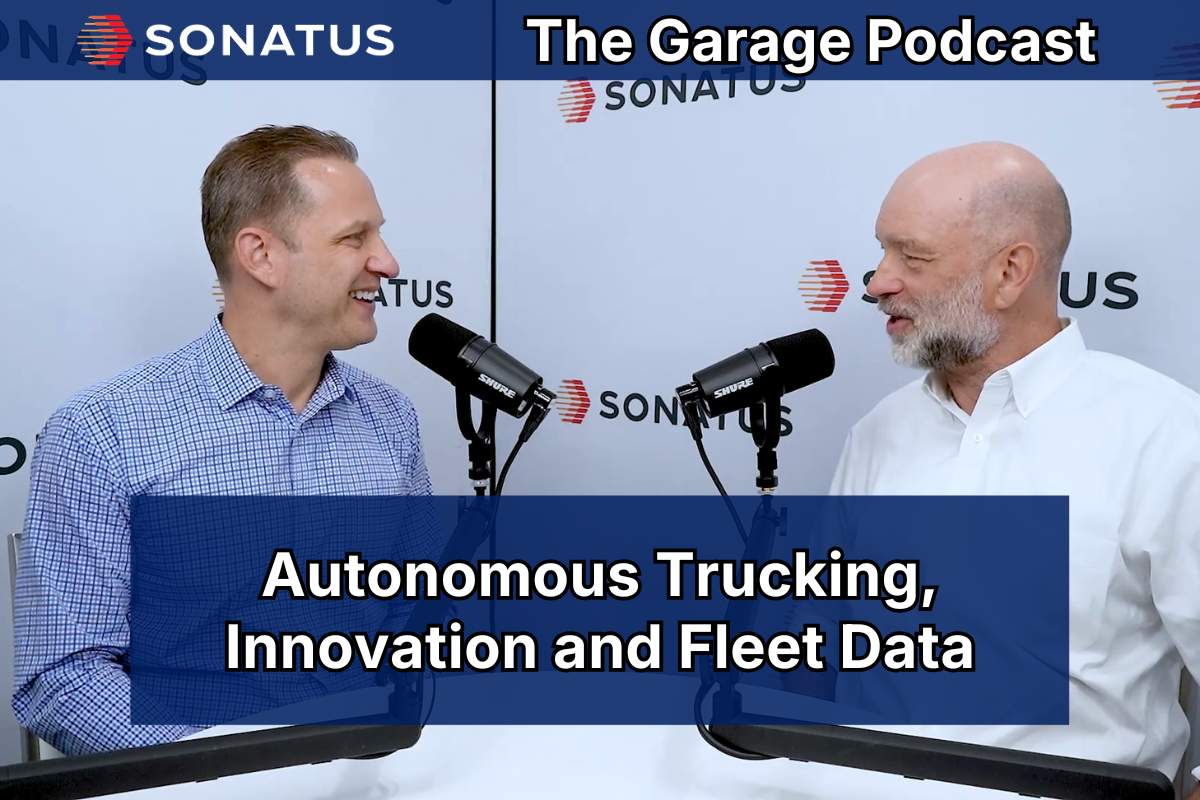
The Garage Podcast : S4 EP13
How will vehicle experiences evolve with AI?
with Mel Roberts of Stellantis
Recorded live at Auto Tech 2026, host John Heinlein speaks with Stellantis's Mel Roberts on how AI and small language models (SLMs) are transforming the automotive user experience. They discuss the strategic deployment of AI in vehicles, focusing on local processing for low latency, predictive maintenance, and balancing physical controls with digital UX design.
Listen to audio only version:
Episode Transcript | How will vehicle experiences evolve with AI?
Table of Contents
0:00 Introduction
Today in The Garage, we’re recording live at Auto Tech 2026 in Novi, Michigan. Just last night, we were participating in the Auto Tech Awards, including Wards Ten Best Interiors. And one of the things that the interiors awards celebrated was innovation in vehicle experience and user experience for the driver and passenger. And you’re seeing an evolution of how features get presented to drivers, both in terms of the displays, voice interaction, which controls are physical controls for things like volume or climate, which are soft controls on screens that are tactile and change over time. And just the use and way these things are evolving is changing all the time and user appetites are changing all the time. It’s a really exciting application of software. And as software-defined vehicles evolve and as we bring more AI into vehicles, there are exciting new ways that we can use software and AI to improve the user experience. To talk about that and learn about that important topic, we brought on an expert, which is Mel Roberts—our guest today is Mel Roberts—she’s director of North America Infotainment and Feature Planning for Stellantis. And in our conversation, we talk about the user experience in many ways, how the user experience is evolving, and how software and AI can enhance that experience now and in the years ahead. It’s an exciting conversation, and I think you’re going to really enjoy Mel’s unique perspective.
Let’s go!
1:48 Meet Mel Roberts
Welcome to The Garage. I’m John Heinlein, Chief Marketing Officer with Sonatus. We’re here recording live at Auto Tech 2026. Mel Roberts, welcome to the podcast.
Thank you.
You know, we’ve been talking for years about having you on the podcast. We’re I’m glad our finally, we’re able to get you on the show.
Very excited to be here. Thanks.
Start by telling us a little bit about you and your background.
Absolutely. So I graduated from Michigan Tech, and I started my career in the medical industry. So I was working at a hospital as a bioelectrical engineer, fixing medical equipment.
As you do.
I mean, it was fun. Every day was a different a different story. And then after that, I went into medical research, found myself accidentally doing microsurgery on rodents for a microcirculation model, realized I wasn’t that good at it after a while. And so I went back and talked to one of my mentors from my undergraduate career, he said, what did you really when you were eighteen, what did you wanna do when you grow up?
And I said, I wanted to do crash test dummies. He’s like, well, you’re not even in automotive. I’m like, that’s a valid point. Yes.
So he introduced me to someone. And long story short, I ended up automotive and will never look back. I loved it, And I don’t miss the mice nor the rats. Although sometimes I still have stress dreams about it, but happy to be here.
It’s just such an incredible background that people’s journey I mean, when I began my journey, I’ve been in technology of many different kinds. I didn’t know I’d end up working in automotive technology, but it’s a super exciting space.
Absolutely.
We always like to get to know our guests. You have to tell us a fun fact about you.
Okay. Well, also, at that illustrious college in Houghton, Michigan, Michigan Tech University, I was a college radio DJ. Cool, was there a style you specialized in?
Yes. And that is the tricky part, three hour show, all on punk rock. So it’s like, what, a minute and a half, two minute songs. I hustled. I gotta work out every CD and vinyl because that’s what we had.
We didn’t have This was a digital music. There was no digital then.
No. No. No. No. No. So the whole, you know, DJ station looked like a mess, a tornado after I was done.
Everything was ripped off the walls. But I had a huge following because we had the biggest transmitter in Michigan. So I had a huge following at the local Baraga County prison and got lots of fan mail.
And Proposals from prison?
Absolutely. No end in sight.
That is hilarious. That is hilarious. So I always share a fun fact back. My fun fact is I’m a podcaster.
That’s awesome.
No. But all joking aside, when we started the podcast, we it was an experiment because we really wanted to engage, you know, thought leaders. And it’s been a great experience. I really enjoyed it. And I was not a radio DJ in college, but I’m jealous that you got to do that. And punk rock too, that’s super fun.
Yes.
4:42 About Stellantis
So tell us now about Stellantis. For those of our listeners who may not know Stellantis very well, it’s a famous company. You know all the brands that Stellantis makes and also about your role there.
Yeah. Don’t quiz me on all fourteen. No. I’m kidding.
Fourteen brands.
Fourteen brands now with the Stellantis merger. And, it’s pretty incredible just watching and learning about all of the new brands that have come in the fold since since we have the merger between FCA and PSA. And it’s been really cool to just be a what our CEO would call us, a a strong global company with strong regional roots.
So FCA, so Fiat Chrysler Alliance, a lot of the, you know you know, Dodge, Chrysler, Ram, all those Chrysler brands, many European Fiat Fiat.
There’s many others in there. You name a few. We’re not gonna get fourteen.
Peugeot, Lancia.
Right.
Of course, I loved my Fiat five hundred Cabriolet.
Oh my gosh. That’s a cool car. Give me that car back.
So so, anyway, many brands under the Sonatus umbrella. And then what’s your role for Sonatus?
Well, I am focused on the North America brands. So my Jeep, my Dodge, my Ram, my Chrysler, those are my four babies. That is where I spend my time.
And and your your scope of responsibility is on infotainment and feature planning?
Yeah. So any feature, anything that the customer would interact with. Certainly, my time from my first job of cup holders, cup holders are still one of the most important features to our customers. If I bring it up, it will ignite a passionate response in anybody I talk to.
Trash management to, yeah, all the new digital features that we can do, things that are coming up on the infotainment. Safety and peace of mind is always very important and critical to our customer base.
On the podcast, we we focus on software, and especially these days, we’re spending most of our time talking about AI. So let’s start by beginning with exploring how OEMs are typically using AI in vehicles today, and then we’ll go on a journey about what we can do in the future. So what’s your experience where what are typical ways AI is used in vehicles so far?
6:50 AI in Vehicles: Current Applications and Future Potential
I think a lot of people are talking about that surface level interaction with the customer that we’re kinda seeing on the phone. So the enhanced conversational personal assistant. But I see much more power than just that. And so while that’s cool and that’s interesting, it’s fun, and it’s gimmicky, could I sit there and tell my my car, hey, instead of this dashboard graphic, I would like my dashboard to look like I’m in Gotham City at dusk. Right? And then the whole mood of the cabin will change. That’s cool.
Yeah. Right? But AI is very powerful.
Yeah.
And we have to start talking about the return on investment and what is the value for the customer. Does the customer need that Gotham City dashboard? Maybe. Maybe not.
So I’m really exploring what are those value propositions and where should we strategically be using AI.
7:47 LLMs vs SLMs
I think when many people think about AI, I think there’s a a feeling that maybe people really mean LLMs or large language models. But the reality is that’s just one small part of it. Everyone knows ChatGPT or Anthropic, very topical these days. But there’s actually much more to it than just those simple models.
And some people talk about SLMs or small language models.
Can you tell us what is this what is an SLM, and and what are other ways we should be thinking that AI could be part of the story?
Well, it’s interesting you asked that. And because of these conversations I have with the amazing supply base and the technical experts that I meet at conferences such as this, they’ve been educating me about the importance of an AI orchestrator and making strategic decisions and highly trained small language mod models. And the importance for that, as it’s been explained to me, is then you can decide. We all know that large language models are very data intensive, and that’s costly.
So we also know they have a lot of artifact. So if I, as a customer, ask my car, what is that icon that’s on the dashboard, or what is the sound that I’m hearing? I don’t want that command to go out to an LLM that reads a Reddit thread of some conspiracy theory. I want it to go to the trusted information, the grounded AI.
I would rather it retrieve that information locally because it should be small enough to fit within our our edge computing environment. I want it to get that answer with low latency, and I want it to be accurate, and I want it to be exactly the correct answer when it has to do with vehicle functions and vehicle safety. If I’m asking about, you know, Taylor Swift’s wedding day, okay. You can go to the LLM for that.
You can go to Reddit for that. I don’t care.
So two or three interesting things you said there. One is that SLMs, because of their small, that’s the s in SLM, they don’t have to have the same kind of massive compute intensive capabilities. You know, we’re talking about building data centers near rivers so they have enough hydroelectric power to power the data center. I mean, that’s not a car.
So it’s something that could be in a car first. Second, and I’m so glad you mentioned that, the trusted data sources, because SLMs can be more tailored. They can be more customized and built on authoritative proven sources that are known and trusted and viewed and reviewed by the OEM. So I think that’s really, really great.
And finally, they can be in the vehicle. So latency, whether it’s response time or responsiveness just in general, can be much more powerful. It’s really great.
Yeah. And, you know, as I eavesdrop on conversations around here or at CES earlier this year, you know, you hear a lot about, oh, AI is scary. AI is error prone. AI is gonna take our jobs.
It’s going to you know? And it’s all of these big things that AI is a tool. Every year, there’s a new tool that we’re both equally concerned about or, you know, excited about and and both at the same time. So for me, it’s all about choosing the right way to use this tool.
You don’t come in with a sledgehammer when you can come in with a nail file.
I love how you said that in in what we people think about AI as monolithic, but the reality is the artifacts come when you’re trying to solve very general purpose knowledge. When you look at application specific AI, the answers are very reliable, very trusted.
And they’re also they they don’t need to be complicated over overly complicated, as you say, the sledgehammer. That’s a great great example. Yeah. Another thing when people think about LLMs, I think they immediately connote LLMs with voice and voice commands. And I’m sure as part of your responsibility, you look a lot at voice interactions in vehicles and what cases people will use voice commands for and whatnot. What’s your take on voice and and how voice interactions in the vehicle have evolved?
11:54 The Evolution of Voice Interactions in Vehicles
The evolution of voice is really interesting. Some people are doing it better than others. And I also see it it’s almost like a horse race where you think someone’s out in front and then someone takes over.
And I think that in vehicle going forward, a multimodal experience is gonna be great because what I notice sometimes when I’m doing voice interactions, you know, in vehicle or out of vehicle, predominantly actually outside of vehicle, is the regurgitation back can be lengthy and clunky, and I don’t have time for that. Right? So I would like to see because we have these beautiful screens in the car, because we’ve embedded lighting and other, you know, audio cues, visual cues, let’s have a great multimodal experience where if I ask for the weather, maybe it displays on the screen instead of reading me each day where I’ve forgotten what happened on Monday by the time they get to Thursday. If I am asking the vehicle to turn up the I’m I’m cold.
Right.
You know, make me warmer.
Maybe it’s a subtle ambient lighting switch that just gives me the red that says, yes, I heard you, and I’m making it warmer. And blue would be make it colder. So combining those multimodal cues, I think, is really interesting.
It lets the user know that the vehicle is responding to you but in a less obtrusive way. And what I noticed even just coming down here today with all the detours to get to Novi from where I’m from is my GPS is competing with my SiriusXM, and I was not pleased because it’s talking over each other. Right. But there were things I needed to know, and I was glad that she told me that there was a cop ahead, or an emergency vehicle or a detour. I also missed the punch line on on the show I was listening to. Shout out to Howard Stern.
Don’t cut that.
No. And and I think that it’s so interesting because voice, of course, has become more popular, but there’s also moderation to everything. If you do everything with voice, it can be overwhelming. And and I think everyone’s personal preferences are different.
Some people love to be talked to and they would they don’t wanna be distracted with UI, but I think it’s all too easy for everything to to be singularly voice and be overwhelming. You know, we were here last night at the Auto Tech Awards, and they always do Wards Ten Best Interiors. And a number of vehicles won won awards, including a a Jeep was one of the ones that won an award last night. But it talked about it was very funny.
14:30 Balancing Physical Controls and Digital Interfaces
The judges said the focus and the shift these days is actually back towards a balance between a changing sort of screens that had that can reconfigure and hard controls for audio or climate or whatever it is. And they were really looking, and they talked about this repeatedly, a balance between kind of application specific single function controls and screens that can reconfigure.
It’s so important, and we have to keep an eye on that and what the customers need and how they interact. And if you remember, the one thing that they shouted out when Jeep got their award was rear audio controls, which is a huge, huge discussion always.
And people that haven’t had it, they’re like, but once you have it, you do not wanna let go of those rear audio controls. And I think it’s a little bit about a power struggle in my own car because my fiancé will try to turn down my punk rock subtly, and I’m turning it up on up on the manual button. He’s turning it down like when he thinks I’m not looking. So but for the fact that Big Brother’s turning down my punk rock, the the volume controls, physical volume controls being dedicated…v ery important. And there are certain buttons like that that we need to remain hard buttons.
Right. Right. And you mentioned a couple of those. I can’t remember how many times they mentioned how much they were happy with the placement of the cup holders last night.
Yes.
Because that’s not the subject of the podcast, but how crazy is it that that’s a really big focus, but it matters.
It does matter. And I was kind of ruminating on the fact that I think the next big evolution in cup holders is actually going to be cup holders and the other perennial unmet need of the cabin. Phone holder….OK, maybe I’ll give you that. I think I think there’s enough solutions to that, but I am thinking… purse storage.
Purse storage might not be your top concern, but it’s many people’s top concern. It’s a perennial unmet need. And the technology that I believe that’s going to solve this Yeah. Is steer by wire, believe it or not.
I think getting all of those mechanical monuments out of my cabin and getting Yeah.
More leg room and more space.
That space back to prioritize the space for what I needed, which is more cup holders. I need all the drinks and my purse.
Well, there you go. There’s a first there’s a first for The Garage, purse holders.
16:58 The Importance of Personalization in Automotive UX
You mentioned a number of topics around personalization.
And personalization has really been changing a lot in these days with some vehicles being hyper personalized, and we’re seeing some interest in that in the survey we recently did. I’m sure we’ll talk about that a little later. What’s your take on personalization and and where we are as an industry?
I have seen that one ebb and flow as well.
When we were taking a look at and benchmarking infotainment maybe three to five years back, it wanted to be the industry was endlessly, I’m gonna configure this. I’m gonna swipe this over from this screen to that screen, and I want my widgets to be exactly what I want them and and the same shape and the size and customize. And I think what we found is those are underutilized features and sometimes considered digital clutter. They don’t necessarily want big customers to have to go and reprogram their whole a superuser might. But not everyday customers wanna sit there and hyper personalize their entire screen. They want us as the experts in UX and UI to say, this is the right information to display in the right place in the right time.
Right.
And that to me is the key. And when we can do that and utilize these new tools with respect to AI and customization and connected data, real time alerts going to the right location, And also just I’m a huge fan of the HUD, the heads up display screen and getting information prioritized over there. So I think that will be a better level of personalization for us. And then the the second aspect I would think that is an emerging and unmet need that will start to grow is climate because I think we have the tools now.
It’s just a little bit expensive. Right? We have the tools. We can scan your body heat.
We could say where should we direct the air.
Oh, automatic Yeah.
You know, we know how to do it. We can motorize a vent. We can scan your body, but it’s expensive. So I’m curious to see what AI can do to help us redeploy those oscillation patterns and make it more like a custom Dyson experience within your cabin.
It’s so unique. I never heard that anyone suggest the idea because, of course, you have you can set, you know, automatic temperature, it changes the fan.
But the reality is different passengers, men, women, tall, short, you know, may have different kind of body experience for when they’re so really adjusting it even more than we think of as auto today. Yeah.
Is that’s very powerful.
Well well, that and sitting just sitting right here. Right? Like, got the lights on me. It’s like I’m a little I got some hot spots. Like, you know?
Like, I would like some subtle breeze gently direct it…mental note we will add a subtle breeze to the future.
The hair blowing back.
Yeah.
You know, and the other thing you mentioned was about thinking about the UX design. And and we work with a number of different user experience, user interface designers in our company and other companies, and it’s an important profession. Those experts really think through about how to present information in a smart way. And I know for my vehicle, I’m I love how it was clearly very thoughtfully designed, and it’s not very personalized.
Well, there’s some there’s some careful personalization about some information I can choose to show or not. But fundamentally, it’s just thoughtfully designed. I get in rental cars sometimes, and you have the ability to really move screens around in kind of, I think, in me, frivolous ways. And a lot of the screens are hard to read.
And as a rental car, it’s kind of almost unsafe because you wanna make sure that the key information is viewable. So I really celebrate the thoughtful UX design coupled with tasteful, sensible customization for maybe people’s personal for example, entertainment or not, for example, or maps or not, for example.
Yeah. I think that’s the right way to go. And I also think that with increasing levels of autonomy, that becomes even more important. So I love to deep dive these things with the thoughtful experts at our company because like you said, it it it’s very carefully designed, every aspect, and they have words and terminology and and rationale as to every little piece of it.
But for me as the end user, what I really need to know is if my car is in one of these higher levels of autonomy. It’s not that I see brake lights ahead of me or I saw a car weaving in and out in front. Did my car see it? And that’s the only way I’m gonna truly be able to let go and say, yes, I will let you have autonomy in this situation. You have to make people feel comfortable that the car is seeing what you’re seeing.
Yeah. I completely agree with you. My car has that capability when I’m in sort of lane keeping mode, lane lane assist mode, kind of cruise control, And the car in front slows down. It’s incredibly reassuring to display on the dash that shows “I see that car ahead, don’t worry, I got you, and I’m going to be slowing down in a in a careful measured way” as opposed to I need to take over control.
And that’s probably my single most important feature to me to know that it sees the car in front. And it does.
I agree with you completely.
Now we recently did a survey with with Omdia. In fact, this show, Informa is is affiliated with Omdia and inform the Informa Group. We recently did a survey of OEMs and tier one professionals. And one of the questions we asked was about best use cases of AI.
22:36 AI for Preventative Maintenance and Smart Diagnostics
Aside from autonomous, of course, but aside from autonomous, one of the most popular use cases of AI was for preventative maintenance and smart diagnostics. And the observation from the survey was that not only is it a great use of AI, but it’s also a strong opportunity to create either customer loyalty or potentially aftermarket revenue source. What’s your take on that? And do you see that as a useful use of AI? And do you believe that’s helpful for your drivers and customers?
I really do. I think I’ve been testing it for years. It always tests really, really well various use cases. I think it’s very similar to what we were calling, you know, dynamic road view with respect to the visual feedback of the car knowing.
So the car knowing other things with respect to tire wear, payload indication, you know, things of that nature, that gives the customer the peace of mind. And that’s what they want first and foremost. They don’t need their car to be as much as, you know, I love an infotainment feature, they don’t need it to be a repeat of their cell phone on wheels. I think the return on investment for AI in those applications is really powerful because when we looked at predictive maintenance in little buckets, it’s like, okay.
I’m gonna put a new sensor on the the brake pads. I’m gonna put a new sensor here. I’m gonna new put a new sensor there. So now I have these new sensors that are costly.
I have to read those sensors. I have to do something with that data. Right. And then sometimes those sensors fail.
Right.
And so people are bringing their cars to the shop, and they’re like, there was nothing wrong with the car, but the sensor failed. You know? And you hear that all the time, and and they’re paying to replace that. And I think with AI, we can have virtual sensors that are, you know, the digital twin that is going to process this data.
And without the added hardware and the added risk of putting that hardware in that could potentially fail, we could get a lot of these use cases. So it almost skips this whole level of where we were trying to deploy these things via one at a time sensor solutions. We might be able to jump that whole scenario and start to bring in predictive maintenance applications much faster with these types of analyses. And that goes back to what we’re speaking about.
And and I think I shouldn’t speak to it too much because I don’t have the depth in this area. But if I understand correctly, the SLM versus the LLM, those highly trained grounded AI models that the experts in the field will develop specifically for those use cases, and we deploy those. So instead of thinking of as AI as, like, salt that we’re sprinkling over everything, let’s take those little grains and decide where are we going to best deploy them. Right.
And in my mind, the predictive maintenance is the key area for true value to our customer.
We agree. And we’re hearing that from our customers as well, that predictive maintenance and and smart diagnostics, I think those are sort of cousins. So I lump those together, is so important. And our AI Technician product we’re we’re exploring right now and showing in the demo, literally just behind this wall, is is showing how you can use a lot of existing data sources to give a better experience.
You also mentioned something that’s so important and I think under-appreciated is we don’t have to put new sensors in the vehicle. A lot of the genius here and a lot of the smarts is taking the data we actually already have and looking at it in new ways. I kind of liken it to a needle in the haystack. The needle’s already there.
If we just know to to look for it and where to find it, we can get the useful information instead of having to to put dedicated sensors for different applications. So it needn’t be a cost burden. It could be a cost benefit.
Absolutely. And I also think that analyzing the data has also become a huge juggernaut in terms of we we thought we had to collect all the data. Now now we have all the data where we’re gonna store it, how are we gonna process it? And the interesting new solutions and the new technology is really being strategic in, I’m gonna collect this data for this time because of this reason, because AI is helping me define those boundaries, And then I can collect less data. I can collect more relevant data, and I can make decisions accordingly. So I think that is another powerful use case instead of this kind of a few years ago mentality where it’s like, let’s collect everything.
27:11 Conclusions
Yeah. Yeah. I agree. I like it to a fishing net sort of just trolling the ocean and you get the fish, but you also get fish you don’t want and lots of broken bottles or whatever.
Just really zooming in on the things you’re looking to capture, I think is so important. Much more sensible with costs, much more sensible with cloud upload bandwidth and storage and all of those things. This has been such a wide ranging conversation. I’m so glad we were able to finally get together and talk.
You’ve brought together your perspective on your customers is so invaluable. And thank you for sharing it with us.
Thanks for having me.
If you like what you’re seeing in this episode, please like and subscribe to see more like it, both from shows like Auto Tech and from around the world. Thanks very much, and we’ll see you again in another episode very soon.
Recent Episodes
The Garage Podcast
How does Subaru choose connected services?
The Garage Podcast
How does 500 petabytes make ADAS smarter?