Introduction
SANJAY: Welcome to another episode of Driving Innovation, the podcast series from Sonatus, where we explore technologies and solutions that are accelerating the transition to software-defined vehicles. My name is Sanjay Khatri. In this episode, we will talk about the challenges of over-the-air updates and how Sonatus Updater, a recently announced product, addresses those challenges. Over-the-air updates, or OTA updates, are an essential part of software-defined vehicles. They allow OEMs to continuously update and enhance the vehicles throughout their lifetimes. However, as vehicle software has changed and evolved, so has the need for an OTA solution. And that’s what the recently announced Sonatus Updater product is intended to solve. Here to talk about the product and those challenges is Jaime Alcantara, Senior Product Manager at Sonatus. Jaime, welcome to Driving Innovation.
JAIME: Thank you, Sanjay.
What is Sonatus Updater solving?
SANJAY: So as I mentioned in the introduction, OTA has been around for a while. There have been products and solutions for that. What is Sonatus Updater solving?
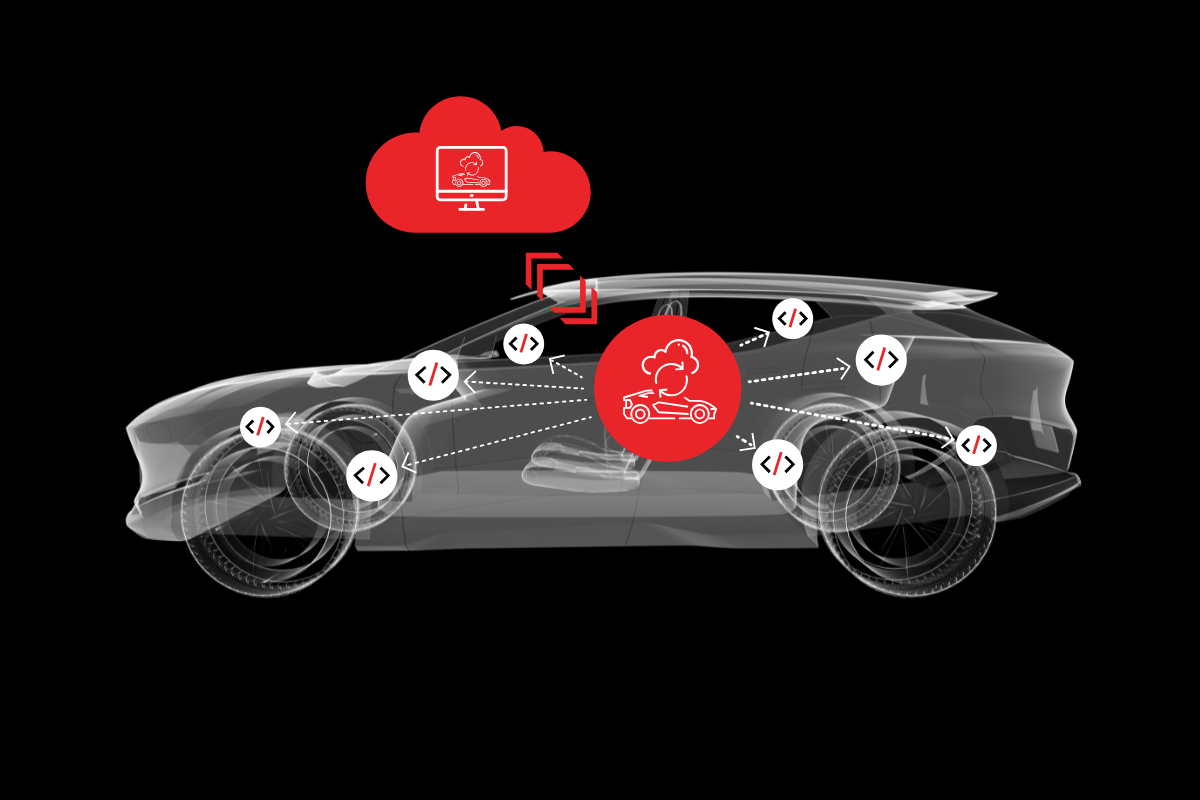
JAIME: Existing OTA solutions focus only on firmware, but the automotive landscape is constantly evolving. So is also the software that’s going into those vehicles. So you can’t focus only on firmware, but you have to broaden your horizon to other software assets, such as containers, configurations for storage, network, compute, and also policies for data collection, or variant encoding. So you need a single solution to manage all those assets, uniformly and that’s not the only challenge that the industry is facing. There are also other challenges around predictability and assessing the impact of a campaign before it actually gets deployed to a target fleet. And you also need traceability, because once things go wrong, and they will go wrong at some point, you need to be able to tell what went wrong in very microscopic detail. And that’s what Sonatus Updater is offering.
SANJAY: I see. So a holistic solution to manage all different types of software assets, also predictability of how those updates are going to run, and then traceability in case something goes wrong. So those are three key challenges that are being addressed by Updater. Let’s take them one at a time. Let’s first talk about this all-in-one solution for all different types of software assets.
JAIME: Sure. So you have your firmware updates, which are like your big gun when you need to do a lot of things in one shot, but that’s not very efficient. What you want to do is, you want to target the updates to the things that you actually want to update. And you can do that by using the containers, the configurations, to deploy very microscopic updates that will only update the thing that you need. That way, you have much more control over your whole OTA system, it’s much more cost-effective, because the size of those updates remains much smaller, and you have much more control over who can deploy what updates, since firmware updates may only be reserved for a certain group within the OEM, versus container updates may be also given out to potential suppliers.
SANJAY: The other challenge we hear a lot about is the cost and complexity of OTA updates, and quite honestly, that’s one thing that’s keeping OEMs from doing this more frequently. How is Updater solving that issue?
JAIME: So Updater is solving that issue by providing the capability to do dry runs before actually deploying a campaign. So that actually gives you the possibility to see what’s the impact of the campaign in terms of cost, effort, how many failures you’re going to expect, how to actually resolve those failures. So you have a complete report, that’s going to give you insights into what’s the impact of this campaign going to cause. So if you notice something is wrong, you can actually go back and change it. You may change the campaign from cellar only to also Wi-Fi to reduce the cost, and you can also deploy other campaigns to solve cross dependencies. So you can actually make sure that your campaign is ready for the intended target fleet.
SANJAY: That’s really an important aspect–knowing upfront what your cost and effort is going to be and where things may fail. It would certainly be something that’s very valuable before you do something as significant as an over-the-air update to a vehicle. The other challenge that we hear a lot about is you don’t really know what’s happening once you actually do the updates: where things have progressed to, where things may have gotten stuck, where things may be going wrong. What does Updater do to address that type of a challenge?
JAIME: So even though we all want updates to succeed, there are cases where updates will go wrong. And in those cases, as an engineer, you actually want to have access to all the data possible to be able to assess what went wrong. For that, we have traceability, and traceability really gives you very granular visibility, completely end to end, from the cloud, to the vehicle. From all the processes that are involved in the OTA update, all the way from sending the campaign from the cloud to the vehicles, and within the vehicles, what’s happening at the individual ECU level, and at the individual asset level. So that gives engineers all the tools necessary so that if something goes wrong, they can actually go back and figure out why it went wrong. And paired with Collector, you can actually dig even deeper and collect any logs that have been participated as part of the OTA update. So that gives you the whole set of visibility that you need to be able to keep improving your OTA campaigns. So your success rate keeps improving.
Summary
SANJAY: That was a great explanation. So if I were to recap, there are three main challenges in the current OTA solutions. Number one, being able to manage all the different types of software assets that are becoming more prevalent in vehicles. Number two, having that ability to predictably know what your campaign is going to cost and how complex it’s going to be, how much effort is going to be involved. And number three, having that very minute level of traceability and visibility, so that when something does go wrong, you can troubleshoot it. Well, this has been a fascinating conversation, Jaime. Thank you for stopping by at Driving Innovation.
JAIME: Thanks to you, Sanjay. It was a pleasure to be here.
SANJAY: That brings us to the end of this episode. If you liked what you heard, click the like button and subscribe to the podcast to hear more technologies and solutions that are accelerating the drive towards software-defined vehicles.