There is a moment that most automotive engineers recognize. A fault appears during a test drive — a thermal anomaly, an unexpected message on the vehicle network, a transient system behavior that shouldn’t be there. The engineer notices it. The test drive ends, and by the time anyone looks at the data, the relevant window of signals is gone — buried in undifferentiated logs or simply never captured at all. So the team schedules another drive to reproduce it.
This is not a data problem. Engineers rarely suffer from too little data. It is an architectural problem — and it plays out not just in validation labs, but across every stage of the vehicle lifecycle, from prototype testing to post-launch field quality management.
I’ve spent years working at the intersection of vehicle software and intelligence systems, and the pattern is consistent: the automotive industry has built a sophisticated data infrastructure without building the intelligence layer that makes it actionable. We collect. We store. We analyze later, if we get to it. We treat intelligence as something that happens after the data capture — in a report or a dashboard — rather than something that emerges continuously from the vehicle itself.
The Problem with Episodic Intelligence
The dominant model for vehicle data intelligence today is episodic: it captures a moment but not the cause, and it requires human judgment to connect the two.
In validation, this shows up as the re-drive problem. A test team runs a prototype through a complex scenario — highway merge behavior, cold-start thermal cycling, ADAS edge cases in mixed-traffic conditions — and something anomalous occurs. The data logger wasn’t configured to capture that signal. Or it was, but the capture window was too narrow. Or the right cross-domain context simply wasn’t collected alongside it. The team has a symptom and no root cause, so they go back out. On a constrained prototype fleet, where each vehicle represents a significant investment and test schedules are already tight, the cost of a re-drive isn’t just fuel and miles. It’s engineering time, prototype availability, and schedule risk against a time-to-SOP deadline that is detrimental to move.
In the field, the same architectural limitations surface differently. A fleet quality issue emerges — warranty claims begin clustering around a specific failure mode, or a pattern surfaces in service data. By the time the engineering team has assembled the evidence needed to diagnose the root cause, the failure has already reached customers at scale. The intelligence arrived too late to change the outcome.
Both problems share the same root: the system was designed to store data, not to generate understanding. There is a meaningful difference between having access to data and having access to intelligence — and closing that gap is what the Agentic Loop is built to do.
Introducing the Agentic Loop
The Agentic Loop is a closed-loop intelligence architecture in which each stage feeds and refines the next, continuously, without requiring manual intervention to trigger the cycle.
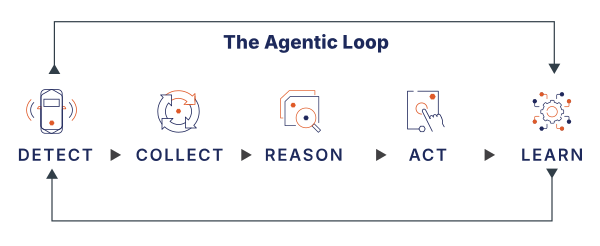
Five stages. Each one precise and deliberate:
- Detect — Continuously monitor signals across vehicle domains to identify anomalies, deviations, and conditions worth investigating, in real time.
- Collect — Trigger targeted, context-rich data capture precisely when and where it matters — not bulk logging, but intelligent collection tied to detected events.
- Reason — Apply AI-assisted analysis across multi-source data to form hypotheses, identify contributing factors, and surface causal conclusions.
- Act — Surface insights to the right engineer, push a configuration update, or trigger a service recommendation — autonomously and appropriately.
- Learn — Feed outcomes back into the detection and reasoning models so every subsequent cycle is sharper than the last.
The “operating system” framing is intentional. Just as an operating system doesn’t run the application — it creates the conditions for applications to run effectively — the Agentic Loop doesn’t replace engineering judgment. It abstracts the complexity of vehicle data so that engineers can focus on decisions rather than data wrangling. Validation engineers, quality managers, and after-sales operations can all run on top of the same intelligence loop — the way different applications run on a shared OS — each getting what they need from a shared infrastructure.
That’s the shape of the argument. But “operating system” is an easy metaphor to state and a much harder one to earn. It only holds up if each stage of the loop actually does what’s outlined above.
In Part 2 of this blog post, we walk through the Detect, Collect, Reason, Act, and Learn stages individually, and lay out what changes at each one.