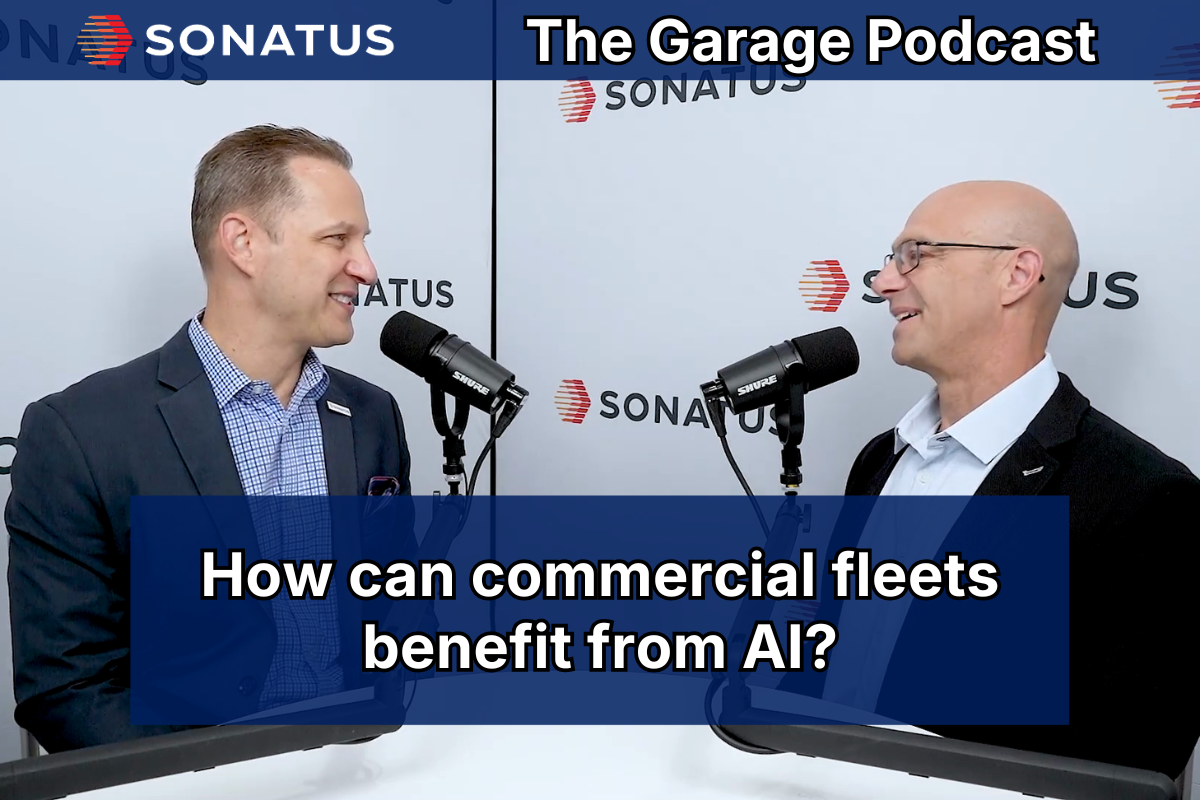
The Garage Podcast : S4 EP12
How does Subaru choose connected services?
with Amy Sgrignoli of Subaru of America
Recorded live at AutoTech 2026, this episode of The Garage features Subaru's Amy Sgrignoli discussing how the brand prioritizes safety and customer experience in connected vehicle technology. Sgrignoli also shares her philosophy on servant leadership and introduces her new podcast, Learn to Lead Differently.
Listen to audio only version:
Episode Transcript | How does Subaru choose connected services?
Table of Contents
0:00 Introduction: Vehicle Experiences
Today in The Garage, we’re recording it live at Auto Tech2026 in Novi, Michigan. As we’re looking around the show, there’s incredible cars. And just off off the studio here, we have exhibitions of Ward’s Ten Best interiors and we attended that award session just earlier this week. And that is celebrating the user experience.
As the driver sits in the vehicle, what do they experience? What are the finishes like? How are things arranged in thoughtful ways? And it’s so interesting to see the diversity of how vehicles present themselves to a driver.
In a similar way, I think different brands are always looking to explore how they connect with their driver and is there a brand profile of their drivers? And what you find is in some cases, are some really clear brand profiles. One of those brand profiles that’s very notable is Subaru. They have a long history of delivering a kind of adventurous like spirit.
People, love their Subarus, drive them for hundreds of thousands of miles and take them on camping and, adventures of all shapes and sizes. And it has informed the way they’ve thought about their experiences and their connection to their drivers. To talk about that, we brought on an expert from Subaru, Amy Sgrignoli. She’s Vice President of Connected Vehicles for Subaru of America.
of America. And in our conversation, we talk a lot about how do they connect with their drivers in unique ways. We also do a little bit on leadership. So a little bonus section of the podcast today on leadership and helping your teams be successful.
I really enjoyed today’s chat, I hope you will too. Let’s go!
1:56 Introducing Amy Sgrignoli
Welcome to The Garage. I’m John Heinlein, Chief Marketing Officer with Sonatus.
We’re recording live at Auto Tech 2026 in Novi, Michigan. And my guest today is Amy Sgrignoli. Amy, welcome to the podcast. Thank you.
Thank you for having me. We’re we’re so excited to chat with you. Why don’t you begin by telling us a little bit about you and your background? Sure.
As you said, I’m Amy. So I work for Subaru, which we’ll talk about later. But me as a person, I have two kids. One who just finished their freshman year college, one who’s about to finish her freshman year of high school.
I born and raised in Colorado. Boulder? Yes. Went to school in Boulder. And then spent a little short stint in the Atlanta area and then have been out on the East Coast ever since.
And you live in Philly? Yes. A suburb of Philly. So right outside of Philadelphia. People know the area Media.
Okay. I’m originally from Pittsburgh. Oh, very my father was born in Pittsburgh. Lots of Pennsylvania hooks.
Those of you who know about Pennsylvania know that Western and Eastern Pennsylvania are sort of like San Francisco and LA. They’re completely different. There’s nothing nothing the same. And they’re both excellent.
They’re just different. They’re just very different. Yeah. So,
you’ve got to tell us a fun fact about you.
3:05 Learning to Lead Differently Podcast
Okay. So fun fact, I actually just launched a podcast. I know. And I and I listened to it and it’s amazing and congratulations one podcaster to another.
It’s an exciting media. This is our fourth year. We just did this our fiftieth episode, you just did your first. Yes.
Because so we’ve dropped one! So tell tell us about your theme and what do you expect to cover? Sure. So this has sort of been my passion project.
As we’ll get into in a second, I have a real job. Not that podcasting is not. Yeah. But I do have a full time job.
But for me, this is just a bit of a passion project because I believe so much in the power of leadership and I I started thinking about leadership and the framework of it and if you go and look at what’s out there in the space, first of all, it’s so much in this narrow corporate lane. Somehow leadership gets like tied to high executive positions or senior levels. And so one thing I really wanted to challenge was that there is leadership across all industries, across all levels, and it’s really, you know, a huge part of who you are as a person, not necessarily the industry or the level that you’re at.
So that was one thing that I really wanted to do. And then the second thing is I believe in the power of stories. And I think that when people can listen to someone else’s story, sometimes they can feel seen, they can feel heard, they can feel inspired, all of these different things. And I just think that hearing other people’s stories is is one of the best ways to actually learn.
And my final point is, I also think there’s a whole generation of kids…look, they’ve had social media their whole life, and they are setting expectations for themselves that are unreachable and frankly, not even true. So I wanted to highlight the real stories, the vulnerabl e moments, the really tough decisions when things didn’t go well, and to show that people still got to where they are. And in fact, many of those things are what defined them.
So that’s sort of the background. So a lot in there, but that’s why I wanted to do it. It’s so true and I think so often people feel as if you know, CEOs just came…were born and they were a CEO.
Well, it’s not like that or you’re in a field and you were always in that field. You you shared your husband’s story who had an incredible career but really decided to make a life change. Yeah. And how he got there and and he’s happy for it and and doesn’t doesn’t dislike the part he that he got there, but he likes where he ended up and it’s it’s interesting to see that.
And you guys, what’s the name of the podcast? Learn to Lead Differently. And it’s for a couple reasons. Obviously, wanted to take a different approach to leadership, but also full disclosure, I have a child who learns differently.
And finding a space for him where he could grow and thrive was a completely life changing experience for me as a parent, a spouse, and also as a leader. So it’s it is a nod back to all of those schools that understand that not everybody learns the same way. Well, so it’s a bit of a double entendre. Very thoughtful double entendre.
We’ll put a link to the podcast in the show notes and exciting. I know you have other episodes already teed up. Next one drops next week actually. Super excited to see that.
So congratulations. Thank you. Now let’s
get to your your day job as it were. My actual job, yes.
6:26 Amy’s Role at Subaru
So tell us about your role at Subaru. Sure. So I oversee the connected vehicle team at Subaru, which is super exciting and I’m learning even at conferences like this that my department is unique. So I don’t just have the engineering side or just the business side, I have the opportunity of having the entire ecosystem.
That means the P&L, so the financial part, the procurement part, all of the way we measure our KPIs, development and engineering, architecture of the systems, all the way through operations and support and the project management office. So nothing difficult? Nothing difficult. It’s really kind of boring.
Honestly, most most of my days are very boring. I’m sure [sarcasm]
I’m totally sure that’s not true. And so let’s jump in then to talk about that in what’s your philosophy about what you do and and as you bring your vehicles to your customers? So
7:24 Customer Experience Philosophy
at my core, if you look through my entire career, the the main thread you would see that makes it make a little more sense because I’ve had a lot of different roles. But the core thread has been customer experience.
I’m such a believer in the importance of delivering an incredible experience. And so that was one of the things when I first actually stepped into connected vehicle, I had been on the training side of the business before, I actually only had the business side. I didn’t have the development side. And one of the things that’s become so incredible by pulling both of those together is sometimes you can get into this mindset of like the business people give the requirements and then the developers are just supposed to do what they’re told.
And frankly, that’s not how the most creative solutions are are found, right? So when you bring those really different groups together and you’re all working towards a common goal, and it also lets the developers understand the end goal experience from the beginning, not just “here’s the requirements, do what we say”. So that really is my…
I feel so passionately that we are here to deliver experiences. And I know that that’s important to Subaru and and Subaru as a brand has a clear brand identity around adventure. I think it’s maybe even your tagline. And and I have to say just just as a shameless plug, we talked about this.
I leased a Subaru Ascent, which is your largest vehicle. Yes. And I just loved it. We we did a three year lease and I liked it so much that I did another three year lease.
I really really loved that. Actually, my lease just ended so I’m in a different vehicle now, but I’m gonna be excited. We’re gonna get you back. Maybe in your new EV platform, I’ll be excited to try that.
But I really did love it and it was for example, we go to the the mountains a lot. It was incredible in the snow, but it was also incredible around town. So having a vehicle like that that was so diverse, I loved it. I loved it.
Also comfortable and well appointed. It it didn’t feel like a truck. It just it was just a beautiful balance for me of the experience. So hats off to you.
Thank you. But the other thing is thinking about how the the driver experiences it. And so as you’re talking about connected services, what sort of connected services do you think about?
9:43 Safety and Adventure in Connected Services
I would say there’s two things I’m the most passionate about.
One, customer experience and maybe within that experience, safety. So there is nothing more important to me than the safety of our drivers. I happen to have a son who started driving a couple years ago and it, you know, it’s made it even more important to me. But truthfully, I have, you know, aging parents.
I have a teen driver. In automotive, we produce products that not only like enable people to live the lives they wanna live, but we need to keep them safe doing that. Right? This is you know, I get it.
We say that, oh, they’re becoming more and more of a device on wheels. Let’s not forget about the fact that that device on wheels is still carrying the lives of people. So for me, safety is always going to be in in front and center. And then I would say the other super fun pillar is adventure.
Right? So and we can combine those two things. Right? We can be adventurous and safe at the same time.
We also certainly pride ourselves on how long our cars are on the road. We have people with you know badges on the back that say three hundred thousand miles. And so that that longevity piece is important as well. So when I look at the connected services, I’m always trying to look through that sort of that vision through our brand pillars and our brand promise because we know our customers really really well.
That’s one thing I think that is so incredible about working for a company like Subaru. And so that experience, we want to deliver the experience they want and need.
11:13 Understanding Customer Relationships
I’ve had this conversation with a few guests recently. Earlier this summer we had one where I think the concern from some OEMs, I think not Subaru, but some of the OEMs is is because actually OEMs sell to a dealer and the dealer sells to an end customer in that case except for the upstart OEMs that are selling directly.
Sure. And I think that that creates some distance between the OEM and the end customer in some cases. But I think you’re trying to counter that and you’re trying to really understand your customers in a different way. Right.
And I also wanna say, I mean, Subaru, we love… we do not have dealers. I would like to say we have retailers. And we go to market in partnership with our retailers. So I wanna be very clearly, like, we recognize the importance of the retail experience.
And when we talk about delivering that customer experience, we have retailers at the table with us from the beginning. So when we are thinking about what that’s gonna look like, we think about how that’s going to drive them back to point of service. In fact, I will tell you, if you ask me in one sentence, what is my job? My job is to keep customers connected to their vehicle, their retailer, and the brand throughout the customer life cycle.
Those are my pillars, and the retailer is just as critical as the other two. And so when you think about it that way, again, it’s the idea of, like, designing the experience you want from the beginning. Our experience is going to include the retailer. And I agree with that.
And my my personal experience having been a customer is I think the the retailer — I’ll say the word retailer, not dealer. The retailer experience was great. I mean, facility was great. I just think the the personality, it didn’t feel like a salesy experience.
Felt much more of an experiential thing. So I really believe what you’re saying, but I think it’s a great philosophy. And I think that that direction is what my other guests have said is that there really needs to be that better connection to the to the customer, to the driver. But don’t do it…don’t
try to leave the retailer out in that equation, right? You can both have that relationship with the customer and both help each other’s relationship with the customer. You know, we can develop the brand and really bring them into the brand. And then the rest of their experience, that point of sale, point of service, that’s going to happen through the retail network.
Well,
13:31 Navigating Technology Complexity
thank you for sharing that. I wonder, know, we were also chatting and I know you’ve you’ve you’ve spoken here at the the show a couple different times about software and technology and complexity and how that’s evolving. And I know it’s it’s getting to be quite a complicated landscape. It is.
And I know you have an opinion. I’d love to hear your your take on that. It might not be a popular opinion, especially at AutoTech. I think that we we are making things very complicated.
And sometimes I think we can be our own worst enemy. The tech is really exciting. Also, it can get really complicated. And again, I want to kind of return to the anchor that at the end of the day, we are building products in automotive that people are driving and people are carrying other people in.
And so when things get complicated, first of all, can be overwhelming, it can be frustrating, and in a worst case scenario, it can be not safe. Yeah. And so I really think that that’s why we can’t think about technology as the end game. Like, we aren’t building technology for technology.
We are building technology to deliver on an experience. And so if we don’t think about that human from the beginning, if our tech is making it harder for them Right. We we have to reckon with that a little bit and we need to rethink how we’re doing it. Right.
Yeah. It’s true that I think a lot of there’s been a bit of a a back and forth about how complicated, how personalized, how intricate. And I think a lot of experiences, I travel a lot, I rent cars and a lot of times you get a dashboard experience that’s unnecessarily complicated. Yeah.
I’m driving a very nice car in this particular rental and it’s like, why is this gauge in front of me? I do not need to know that. Yes. It’s just completely unnecessary.
It’s like real estate, what am I doing? And it’s actually distracting because like, what does that mean when I be paying attention to the road? Yes. I mean, it’s true.
And so I think. Look, I also think there might have been an idea a few years ago that we were gonna get to these level four, level five, like, cars sooner than we have. Let’s remind ourselves, people are still driving these cars. There will be a time when maybe that is not the case, but what we can’t do is say, let’s put the tech in the car assuming they’re not actually driving the cars because they are driving the cars.
Right. Even we’re talking one of our earlier guests, we were talking about the different driving self-driving levels. And even in so called level two plus, which is the average high end car is a level two plus. And the level two and level three is is well known is that the level two in how many no matter how many pluses you put, the driver is still in charge.
A hundred percent. Yes. Level three and level four is when you get to be sort of in certain situations, you can you.. Again, and certain is also a keyword here…
But so that’s that’s sort of your point is that we still have to recognize the driver’s still in charge in the vast majority of cases. It’s only a tiny fraction and unless you’re getting into robotaxis where you really can take your eyes off. Yeah. We have to remember that.
Right. We have to remember that, you know, we say that cards are becoming like phones. Well, when you’re looking at your phone, you’re maybe sitting on the couch. Right?
You’re not, you know, taking your child to the doctor. So, you know, we have to we have to understand there are some distinctions there. I think you you as far as the user experience goes, I think it’s also the case that you have different desires. You have different appetites for technology.
I grant you, I’m a high end technology person. So I’m sort of theoretically interested in advanced technology, but at the same time, actually when it comes to the user interface, experience of the vehicle, actually I appreciate something that is thoughtfully designed and streamlined. So even though I’m a techie Yeah. Kind of a person, I’m telling you that this techie car I’m driving right now, actually I don’t like it.
I think it’s unnecessary. So, thoughtfully designed for safety experience, usability, while at the same time bringing in things entertainment capabilities when that’s appropriate, whether it’s parked or or when it’s safe during the drive or whatever those are. It’s that balance, I think, that everyone needs to look for. A hundred percent.
Yeah.
17:22 Leadership Philosophy and Team Dynamics
Now, you your podcast is about leadership. It is. And I’d love to talk….I know that you have that’s a deeper-held philosophy philosophy for you.
And I and I know I know people that work with you who say that you’re a really genuine leader and you really care about the team… getting the best out of your team. What’s your what’s your philosophy about that and what’s your advice to people about getting great ideas out of your team? So I think for me, it you are only as good as your team. So let’s just start there.
Right? So if you if you think that, like, the leader is good on their own, I mean, that’s just not true. So a leader is only as good as the team that they’re able to build and the team they’re able to cultivate. So I do think about it a little bit in, like, a sports analogy.
It’s like you’re coaching, right? And so that that role, if you haven’t put the right players in the right positions and you haven’t continued to make sure that you’re helping them grow and continue to improve and that they’re not leaving your team, you know, constantly where you have to start over. So that’s kind of my governing philosophy is that you are only as good as your team. Hard stop.
I think another part of that question is, so what does that mean? How do you cultivate a team of people that want to be there? And I think for me, one of the most important things is welcoming and encouraging diverse perspectives. People at all levels in all different disciplines should have a voice at the table.
And in fact, you’re gonna get to the most creative solutions when you not only include those voices, you go out and seek those voices. I mean, diversity these days is getting a bad name, but the reality is: it’s just smart. A hundred percent. Because if you bring everyone who thinks the same, you’re going to get the same answer.
I was just talking with one of our colleagues at our company who’s in a very different part of the business and we were just sort of chatting and whiteboarding about some ideas. And out of that conversation, I ended up with a different perspective from my view and she ended up with a different perspective of how she can help us design better products because she had context that she didn’t get. So everyone benefited. But so the point is this difference this difference of ideas is is very important.
I just don’t even see…okay, let’s look at how diverse my customer base is. So if I don’t have diverse perspectives being brought to the table to do that thoughtful design, we’re not gonna be serving our entire customer base. So, I mean, again, to to your point, it’s really just it’s honestly smart for a business, but it’s also again, we have to think about all those people that could be using our product.
Right. And and their diverse needs, whether they’re…
Hundred percent…
Professionals or moms or older or younger or experienced or not experienced. All of the above. Right. Right?
And can any one of them use our car? Yeah.
20:11 The Role of a Servant Leader
You also talked about and this is an area that we could probably have many other topics on, but you talked about how the leader has to help coach the team. And I’ve done a lot a lot of training on leadership and there was a concept that I was introduced to which I really like a lot called “servant leader”.
Which is your goal is to help the team. And I always tell my team, my goal is I want to help you succeed. Yep. And that sometimes that means giving them hard feedback.
A hundred percent. But it’s also teaching them how to be great and then giving them the resources and then and then also getting out of their way. Hundred percent. I like to say to my team like, if I’m doing my job well, I’ve actually made your job easier.
Yeah. In some way. Right? Whether or not and that can look so many different ways.
It can be I can be a sounding board. It can be I can be a point of escalation. It can be I’m overwhelmed right now. Just help me think through, what I should do.
But ultimately, a hundred percent, that’s the job of a leader is to help grow the the members of the team and really show them what they’re actually capable of. So you gotta push sometimes, right? You can push people. I always like to say, my team makes fun of me, but I always like to say, we’re gonna sit in a little discomfort sometimes because that’s how we grow.
Right? If you always sit in a super comfortable place, it’s gonna be really hard to grow. All that said, always say discomfort is not the same as pain. Those are two very very different things.
But get a little comfortable sometimes being uncomfortable. And it’s so interesting because when you talk about coaching and when you think about guiding people and you you said that you need to meet people in different places, A mistake is to think that, okay, well, I’ve hired this senior person or junior person or whatever. And so the junior person always needs more guidance and the senior person always…
But the reality is for different tasks, different missions, different people may be in a different place. Hundred percent. And they may need different resources or coaching or ideas or independence and it varies by the mission. A hundred percent.
So right. A single person might need more coaching in one something else and be completely independent in another part of their job. Right? So it’s understanding how to kind of modulate that a little bit.
Yeah. There’s there’s an amazing book called Situational Leadership which talks about that. And in fact, it turns out there’s a brand new edition of that book coming out this fall is there really? Okay.
In September. But I’m a huge, devotee of that of that approach. It talks about exactly that and I’ve tried to use that in my leadership. You know, there’s a famous saying from from Henry Ford, which is “I hired employees and people showed up.”
Yeah. And recognizing that your people come in with their own hopes and aspirations and challenges and their parent is sick or their dog died or they just won the lottery. I mean, it’s anywhere in between recognizing that everyone comes to a different place. Hundred percent.
And like, when you know them as people, you are also so able to tell when maybe this day isn’t the best day for them. And there could be so many reasons why, but it’s it’s coming from that empathetic view to be like, I you know, what do you need today? Yeah. What do you need today?
Because I can I can tell you need something, so let’s talk about it? Yeah.
23:17 Conclusion and Future Discussions
And remembering to ask and remembering, don’t assume. Never.
Right. That they’re just lazy… it’s just not like that. It’s just they may have things going on. Absolutely.
And you have to recognize that. Because they’re more than just what you see at work. There’s so much more going on in their lives. Well, Amy, we could probably talk for another hour on leadership alone.
Yes, we could. And then another hour on…We’ll another episode. Let’s do it. But thank you for joining us and squeezing us into your busy schedule.
It was wonderful to meet you and good luck with your new podcast. Thank you. Thank you. Continuing to bring adventure into your vehicles.
Thank you so much. If you like what you’re seeing here, please like and subscribe to see more episodes like it, from AutoTech and from our home studio. We look forward to seeing you in another episode of The Garage very soon.
Recent Episodes
The Garage Podcast
How does 500 petabytes make ADAS smarter?
The Garage Podcast
Autonomous Trucking, Innovation and Fleet Data