
In 2024, Stellantis recalled approximately 1.23 million Ram 1500 trucks after identifying a software issue in the anti-lock braking system that could disable electronic stability control.
What makes the case interesting isn’t simply that software was involved. It’s how difficult modern vehicle problems can be to correctly diagnose. Symptoms can point toward hardware, software, or interactions between systems, and an incorrect diagnosis can lead to unnecessary repairs before the underlying cause is understood.
The broader lesson isn’t about this particular defect. It’s about the time required to turn vehicle evidence into confident action.
The interesting part of this story isn’t the technical defect. It’s the time between the first signs of a problem and the organization having enough understanding to act on it at fleet scale.
Call it quality latency.
As vehicles become more dependent on software, electronics, networks, and connected services, reducing that latency may become one of the most important ways automakers can get ahead of quality problems – resolving issues earlier, before they escalate into warranty claims, service campaigns, and recalls that can cost millions of dollars.
The problem isn’t a lack of data
Modern vehicles generate enormous amounts of information. Telematics and location data. Diagnostic trouble codes (DTCs). Multi-domain ECU signals and logs. Software and connectivity data. Network and bus-level statistics.
Engineering organizations have plenty of information, too: specifications, requirements, issue-tracking systems, previous investigations, fault-tree analysis, service records and warranty claims, and decades of accumulated expertise.
Yet when something goes wrong, engineers still spend considerable time finding the relevant evidence, determining what’s missing, correlating events across systems, and working out what actually caused the symptom.
A problem in an infotainment display might originate in a control unit, software service, network interaction, or somewhere else entirely. The place where a problem appears is no longer necessarily where it began.
So the meaningful quality metric isn’t simply how much data an OEM can collect. It’s how quickly the organization can turn the right information into confident action, and the faster that happens, the lower the cost of resolving the issue
Latency shows up everywhere
The Stellantis ESC recall illustrates reasoning latency: the time between observing a problem and correctly understanding its underlying cause. But that’s only one form.
There’s also scoping latency: how long it takes to determine precisely which VINs, configurations, parts, or software versions are actually affected.
There’s response latency: how quickly a known failure signature can become monitoring or diagnostic intelligence capable of detecting similar conditions elsewhere.
And there’s knowledge latency: how long it takes for what one engineering team learns to become useful to the next program—or whether that knowledge ever makes the journey at all.
Five recent recalls examined in our new white paper, The Shift to Continuous Quality, illustrate these different forms of latency. Different manufacturers. Different systems. Different technical causes. But the same recurring problem: a lag between when the information needed to act exists and when the organization can act on it.
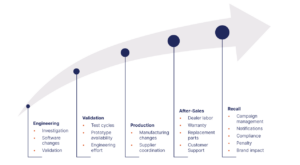
The later you know, the more expensive the problem becomes
Latency matters because the economics of a defect change dramatically as a vehicle moves through its lifecycle.
Find an issue during development and the cost is largely engineering time, testing, and perhaps schedule impact.
Find that same issue after thousands of vehicles have shipped and the technical fix may be no more difficult. But now the organization is dealing with dealers, warranty claims, replacement parts, customer communications, logistics, regulatory reporting, and potentially a recall.
The defect didn’t necessarily become more expensive to fix. It became more expensive because it took longer to understand and act on.
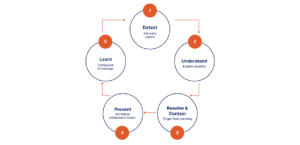
That suggests a different way to think about vehicle quality: instead of optimizing individual investigations, systematically compress the distance between Detect → Understand → Resolve & Contain → Prevent → Learn.
That is the idea behind Continuous Quality.
Move upstream and the economics change
Reducing latency after SOP can make field investigations faster and limit their impact. But there’s a bigger opportunity: move the same capabilities upstream.
During vehicle validation, an intermittent issue might occur once and disappear. If engineers didn’t collect the right signals or logs when it happened, they may have to reproduce the condition just to gather more evidence.
What if the investigation could adapt while the vehicle and fault condition were still available?
At Nissan Technical Centre Europe (NTCE), Sonatus is trialing targeted, event-driven vehicle data collection and AI-assisted analysis to help them do just that. Early results reduced manual data aggregation from 2–4 hours to under 5 minutes, anomaly detection from 4–8 hours to 10–15 minutes, and root-cause analysis and reporting from 1–2 days to under an hour. The program is targeting end-to-end investigations that previously ran as long as two weeks to close in two days. These results are preliminary, but they demonstrate what happens when the time between observation, context acquisition, and engineering understanding begins to collapse.
And that matters because every issue eliminated before SOP avoids entire categories of downstream cost.
Now put intelligence in the vehicle
There’s a third step.
Once engineering has validated a failure signature, degradation pattern, or diagnostic method, why should that knowledge remain in an engineering system? Instead, it can become intelligence running in the vehicle.
A validated anomaly signature can become a new monitor. A degradation pattern can become an early warning detector. When something unusual occurs, the vehicle can help capture the precise context needed to investigate it.
Now information flows in both directions: vehicles inform engineering, and engineering makes vehicles better at recognizing the next problem. The vehicle is no longer simply a source of evidence. It becomes an active participant in quality.
Continuous Quality can take hold at three different stages of the vehicle lifecycle with the Sonatus Fastlane™ Platform. Before SOP, they can bring this approach into vehicle test and validation to find and resolve problems before vehicles ship. After SOP, OEMs can start with existing production data and workflows to investigate and contain field issues faster. And in future vehicle platforms, they can embed intelligence from the Fastlane Platform directly into the vehicle, creating a continuous learning system that connects what vehicles observe with what engineering learns and acts on.
Getting ahead of quality
AI will play an important role in this transition. It can find patterns, correlate evidence, reason across engineering domains, determine what information is missing, and help orchestrate what happens next.
The competitive advantage AI will yield is time: shortening the distance between observing a problem, understanding it, acting on it, and making what was learned useful the next time. Because the best quality problem isn’t simply the one you solve quickly. It’s the one you learn from early enough that you don’t have to solve it again.
Read the new Sonatus white paper, The Shift to Continuous Quality, featuring research and analysis by Frost & Sullivan, to explore the Continuous Quality framework, lessons from five recent recalls, early operational evidence from NTCE, and the modeled economics of moving quality intelligence earlier in the vehicle lifecycle.