0:00 Introduction: Launch of Sonatus AI Director
Welcome to another episode of Driving Innovation, The podcast that explores products and solutions that are driving the automotive industry towards AI-enabled software-defined vehicles.
We have a special episode for you today. We’re going to be discussing our latest product Sonatus AI Director. There’s been a lot of discussion around AI and the automotive industry.
Now a lot of the innovations around AI
have focused on cloud-based implementations. Think of your chat bots or your voice assistants and yet there’s still a lot more potential for AI directly inside the vehicle to make vehicles a lot more intelligent, adaptive, more fun to drive for end customers.
And that is really what edge AI in the vehicle is intended to do. And in fact, that is the challenge that AI Director is addressing. So let’s
get started.
With me today is Steve Stoddard, Product Manager for AI Products here at Sonatus.
Steve is going to go over the launch of the AI Director and what its goals are, and what it is actually delivering.
Steve, welcome back to the podcast.
Thank you,
1:25 What is AI Director
Sanjay. Glad to be here.
I feel like I need to give you some sort of a t-shirt or a mug for your three-peat appearance. So good to have you here. Thank you. So let’s get right to the point. What is AI Director and why are we launching this product now?
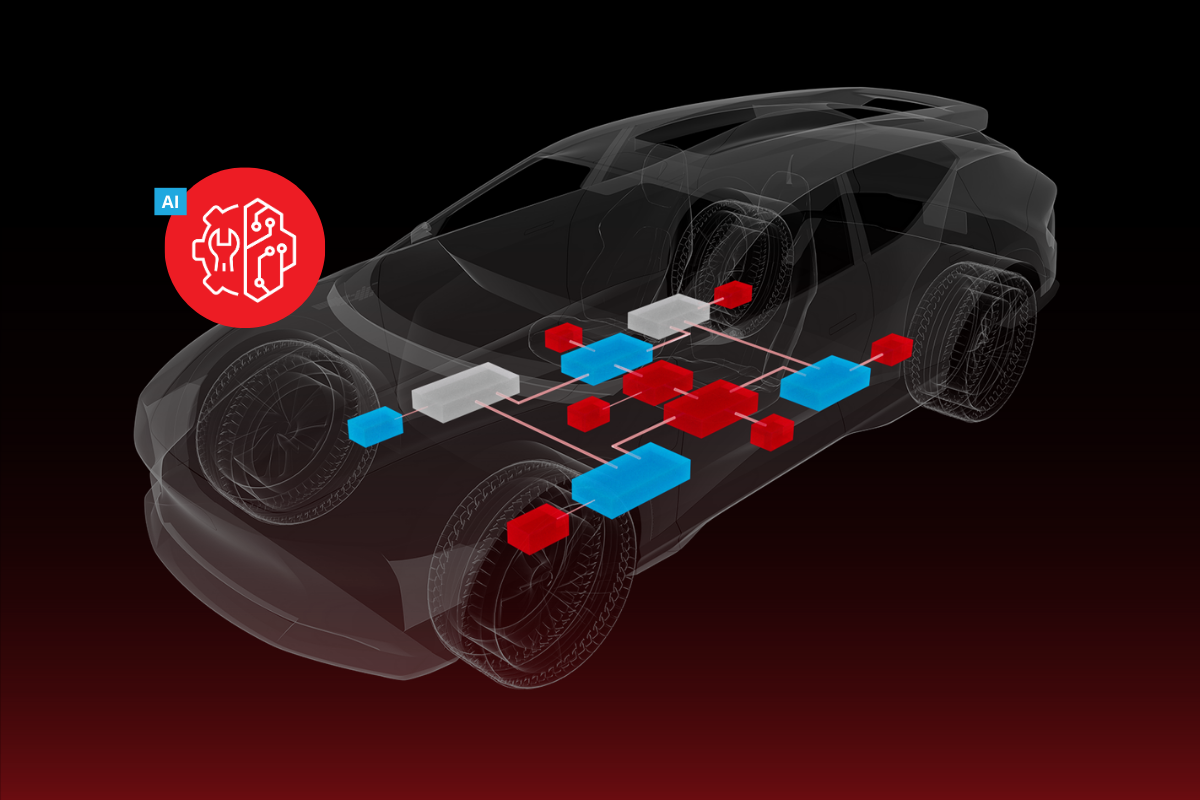
Sure. AI Director is a platform for OEMs to develop, deploy, execute, and manage AI models in their vehicles. And there’s three main reasons that AI is ready to run in vehicles now. The first is that end customers, as well as OEMs themselves, kind of are demanding customization, more personalization, really sort of AI-driven features in their vehicles because it’s with us everywhere today.
A second reason is that with the proliferation of software-defined vehicles and data, it’s really everywhere, and the data costs really become, exorbitant if everything is going back to the cloud in order to run AI models there.
Along with that is data security. Everything that leaves the vehicle is a potential threat, potential leak, and running AI models in the vehicle is a more secure way to do that when it’s possible. And the third reason is really that all the technologies are starting to come together today to really make this possible where just a few years ago, it didn’t really, exist and wasn’t possible as the way it is today.
Yeah. So there’s a lot more potential for AI-enabled intelligence inside the vehicle. I can see how, you know, similar to how, you know, other appliances and devices around us are becoming more intelligent and more catering to our personal needs. The car or the vehicle can also do the same thing.
So help me understand or help us understand a little bit about what AI Director is doing that, for example, other solutions aren’t doing in the market today. Sure.
3:13 Challenges addressed
One of the problems we see is that, actually, there are many different tools for building, developing, and deploying AI models, but they’re tied to the history of AI development and development of the Internet in general. So a lot of cloud-based applications focus on building models that are gonna deploy in data centers where there’s virtually infinite compute available in order to actually execute during the inference time for these models. Another issue is that the data which is needed in order to build these models currently lives in the vehicle. That’s improving, of course, as more data is coming back to the cloud today, but that’s one of the challenges that we’ve seen with our customers and the ability to actually deploy their models.
And the third major area is the fact that these models are going to run in vehicles. So it’s non-standardized hardware. Every vehicle is a little bit different. The different
ECUs in the vehicle have different capabilities and access to different data sources.
And so there really is a need to be able to optimize these models to run in vehicle as well as to feed those models with the right data at at the right time from the different ECUs.
Sure. So what you’re describing is, essentially, a tool chain kind of to end manage the end-to-end life cycle from development, training, development optimization, all the way to actually situating it in the car, and then let it do its magic inside the car. Well, let’s talk about that magic. What are some of the use cases that we envision that automotive companies are going to want to do with AI embedded inside the vehicle?
Yeah. Absolutely.
4:41 Use case examples
So a lot of different use cases really can benefit from AI. One of those is just general personalization. So all kinds of features where you want to customize the way the vehicle’s operating for the specific user.
Another example comes with virtual sensors. Of course, today, cost is everything. And with software-defined vehicles, it’s possible to deploy sensors into the vehicle
virtually through these AI models and eliminate some of the hardware costs as well.
Another area that we’ve typically seen a lot of benefit comes in vehicle cybersecurity. As I mentioned earlier, some of the challenges of removing data from the vehicle into the cloud in order to run these models, all of that need is eliminated once you’re able to run these in vehicle and protect it much better that way.
BMS models or battery management systems is another area as vehicles are becoming more electrified. It’s typically a challenge for OEMs today, particularly as they’re making that transition from ICE into EVs. But, these are typically much more software-defined vehicles as well, and a lot more data goes into properly managing those battery systems and making sure they’re operating efficiently and charging at their optimal values as well. So these are all ripe opportunities for, AI models to run a vehicle.
5:53 Optimizing for vehicle hardware
Sure. So we know we’ve obviously heard a lot about the amount of immense amount of compute resources that, you know, running AI requires. And while vehicles are getting a lot more powerful and capable from an electronics point of view, you still don’t have, you know, the high-end GPUs and NPUs inside the the vehicle. How has AI Director or how will AI Director, overcome these so that you can actually make it practical to actually deploy AI models like the ones that you described, into current generation of vehicles?
Yeah. Absolutely. It’s a very good question. So traditional AI and automotive has been focused on ADAS or autonomous driving, of course.
And this is an area that’s very well saturated. It’s very well understood. But these other different domains, as I mentioned before, don’t have the same level of development that has gone into them. One of the things that we see with AI Director and many of our model partners is that there’s a variety of types of models that people are developing and want to be able to deploy to the vehicles.
So this can
range from everything from very simple sort of physics-based models, maybe linear regression types of things, all the way up to neural network or even LLM-based models. So depending on the type of model as well as the type of hardware that’s in the vehicle, it’s possible to optimize those models for that hardware and deploy it to the right place at the right time so that the right data can feed into those models, to provide the benefit that they need to provide.
7:24 Launch partners
And you mentioned a couple of the use cases, and, I think you mentioned a couple of, vendors as well. I know we’re partnered with, several of them right off, the bat, and I’m sure we’ll be adding more. But can you talk a little bit about some of the partners that we’ve partnered with, in this launch?
Yeah. So it’s a very important ecosystem to bring together everybody all the steps that are needed in this process.
We’ve actually worked with AWS on the cloud side, particularly to implement,
integrate with our model development workflows. Of course, there’s many great tools out there that exist today to train clean data, train models, and then prepare them for ultimately bringing into our system to deploy into the vehicles. And so AWS SageMaker Studio is a very excellent tool for that that we’ve worked with extensively.
On the silicon side and the hardware, we have a very great relationship with NXP, and we partner with them to work closely around optimization, specifically to make them it easier to, optimize those models for deployment into NXP hardware.
8:25 Model vendors
On the model side, we have a number of vendors that we’ve been working with. One of the use cases is a headlight leveling. Out of the EU, there’s a new regulation that’s going to be required, for headlight leveling starting in 2027. And a company called Compredict has developed a virtual sensor to enable that capability, without having to have additional hardware to support that. So that’s a really cool application we’ve been working with.
Another one is on the BMS battery management side, a company called QNovo.
They work with vehicle health battery management and detecting health of vehicle cells, how they’re performing and predicting failures and things like that. So that’s a new model that, a model they’ve been working on that we’ve launched with as well. And, another vendor on the cybersecurity side, VicOne, we’ve partnered with. They have a very innovative new LLM based model that, we’ve been working with to deploy into our hardware as well. And so another, model that we’re demonstrating is an engine anomaly detection model, which we’ve developed internally here at Sonatus. Again, using a lot of the, optimization tools through both AWS and NXP.
NXP. Okay. So a good mix of partners, good variety of different model vendors and so forth. So that really shows the diversity of of the types of models that, AI director can manage and handle. I think, bringing, AI models closer to the edge, closer to the user, I think is an important endeavor. And, we will look forward to additional discussions around AI Director and some of its derivative solutions in the future episodes. Again, thank you for coming by and being so generous with your time as a three-peat guest.
And thank you. Yeah. And congratulations on, on the launch. Thanks so much, Sanjay. Appreciate it.
10:10 Wrap-up: Where to find more details
That wraps it up for this episode of Driving Innovation. To learn more about AI Director, get some more details on the things that we discussed here today, go to the product page on sonatus.com and also check out the more detailed solution brief that you can download. And thanks again for joining us on this episode of Driving Innovation and we look forward to seeing you again in the future.